
 99%+ Purity with 3rd party testing
  10% off first order
  Volume Discounts
  Fast & Free Shipping
  Refund Guarantee
  24/7 Customer Service


AOD-9604 Benefits
What Research Shows
Introduction:
AOD-9604 is a synthetic peptide fragment of human growth hormone (HGH), designed to selectively target fat metabolism without stimulating growth pathways.¹ While initially developed for obesity research, studies have also suggested potential benefits for metabolism, lipid balance, and cartilage protection.
Because AOD-9604 remains an experimental peptide, all reported benefits are based on preclinical models and early clinical work, not established medical evidence.
Potential Benefits of AOD-9604
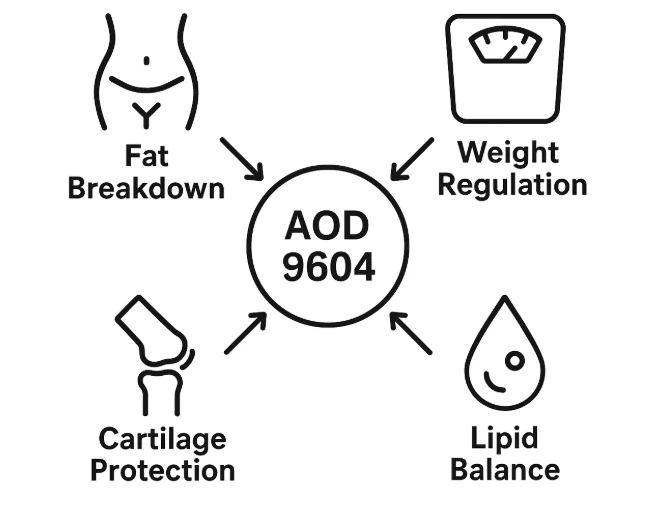
1. Fat Breakdown (Lipolysis)
- AOD-9604 promotes the breakdown of stored triglycerides into free fatty acids.¹
- This effect has been observed in adipose tissue from both lean and obese models.
Key takeaway: May support the mobilization of stored fat for energy.
2. Reduced Fat Storage (Anti-Lipogenesis)
- Research shows AOD-9604 can inhibit the formation of new fat from dietary carbohydrates.²
- In obese rodent models, this led to less weight gain even under high-calorie diets.
Key takeaway: Suggests potential use in preventing fat accumulation.
3. Weight Regulation
- In animal studies, AOD-9604 reduced body fat mass and improved metabolic parameters.²
- Early human trials showed limited direct weight loss, but trends toward improved lipid metabolism.³
Key takeaway: May influence weight management indirectly by altering fat metabolism.
4. Lipid Profile & Metabolic Health
- Some research reports improved lipid balance (e.g., triglyceride reduction) in preclinical studies.²
- Possible improvements in basal metabolic rate have also been noted.
Key takeaway: Beyond fat burning, AOD-9604 may have broader metabolic effects.
5. Cartilage & Joint Protection
Because DSIP is often studied for sleep regulation, it is natural to compare it with melatonin, the most widely used sleep supplement:
- AOD-9604 demonstrated chondroprotective effects in models of cartilage degradation.⁴
- May reduce proteoglycan loss and support collagen maintenance.
Key takeaway: Suggests possible relevance for joint and connective tissue research.
Limitations of Evidence
- Animal-dominant data: Most findings are from rodent and cell models.
- Human trials limited: Clinical data shows modest or inconsistent results.³
- Unclear mechanisms in humans: Translation from animals to people remains uncertain.
Summary
Research into AOD-9604 suggests potential benefits for:
- Fat breakdown (lipolysis)
- Reduced fat storage (anti-lipogenesis)
- Weight regulation
- Improved lipid profile
- Cartilage protection
However, AOD-9604 remains an experimental peptide, with human results still inconclusive.died but potentially broader in scope, influencing multiple systems beyond sleep.
FAQs About AOD-9604 Benefits
What is the main benefit of AOD-9604?
Research suggests its primary effect is fat metabolism — stimulating fat breakdown and reducing fat storage.
Can AOD-9604 help with weight loss?
Animal studies show fat loss effects, but human results have been mixed.
Does AOD-9604 support joint health?
Some early research suggests cartilage-protective effects.
Is AOD-9604 approved for obesity treatment?
No — AOD-9604 is not FDA-approved and remains a research-only peptide.
Related Articles
References
- Heffernan M, et al. “AOD9604, a novel fragment of human growth hormone, stimulates lipolysis in adipose tissue.” J Endocrinol. 2001;170(3):433–442. https://pubmed.ncbi.nlm.nih.gov/11479127/
- Ng FM, et al. “Metabolic effects of a growth hormone fragment (AOD9604) in obese Zucker rats.” Obes Res. 2000;8(6):479–486. https://pubmed.ncbi.nlm.nih.gov/11156424/
- Ng FM, et al. “AOD9604, an analog of hGH fragment 177–191, reduces body weight in obese mice but not obese humans.” Int J Obes Relat Metab Disord. 2002;26(2):191–197. https://pubmed.ncbi.nlm.nih.gov/11850748/
- Ng FM, et al. “Chondroprotective potential of AOD9604 in cartilage degradation models.” Arthritis Res Ther. 2004;6(6):R713–R722. https://pubmed.ncbi.nlm.nih.gov/15535832/
