
 99%+ Purity with 3rd party testing
  10% off first order
  Volume Discounts
  Fast & Free Shipping
  Refund Guarantee
  24/7 Customer Service


Ipamorelin Dosage Guide
Research Protocols & Study Designs
Introduction:
This guide summarizes how Ipamorelin has been dosed in published research and common experimental designs.¹²
Ipamorelin is a selective growth hormone secretagogue that stimulates pulsatile GH release via the ghrelin receptor (GHSR-1a).¹²
Disclaimer: The information below is for educational and research purposes only. Ipamorelin is not approved for human use. No medical advice is given.
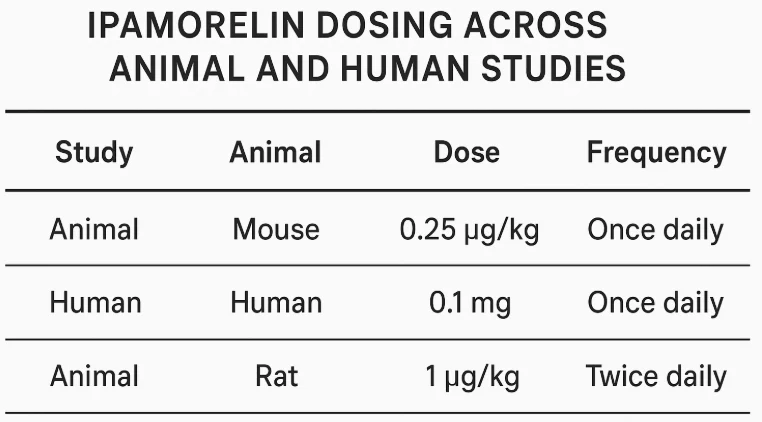
Typical Research Dosage Parameters
| Study Context | Subject Type | Typical Daily Dose Range | Frequency | Duration | Notes |
| GH release studies¹² | Human | 200–600 mcg | 1–3x daily | Single or up to 14 days | GH peaks ~30 min post-dose |
| Muscle injury models⁵ | Rodent | 200–400 mcg/kg | 1x daily | 7–14 days | Supports tissue repair biomarkers |
| Body composition models³ | Rodent | 100–300 mcg/kg | 1–2x daily | 4–8 weeks | Lean mass ↑, fat ↓ |
| Combination with CJC-1295⁶ | Human | Ipamorelin 200–300 mcg + CJC-1295 1–2 mg weekly | Ipamorelin 1–2x daily | 1–2 weeks | Synergistic GH pulse |
TB-500 Dosing Protocols: Animal & Cell Studies
| Study Type | Dose Range | Frequency | Duration | Route | Notes |
| Rodent¹² | 2–10 mg/kg | Daily | 7–14 days | SC, IM, IV | Wound, heart, tendon healing |
| Rabbit / Large Animal³ | 0.5–5 mg/kg | Daily or 2×/wk | 2–6 weeks | SC, IM | Tendon/ligament models |
| In vitro⁴ | 10–100 nM | N/A | Up to 7 days | Cell culture | Cell migration and signaling assays |
1. Human Study Dosage Ranges¹²
In human GH release studies, Ipamorelin has typically been dosed between 200–600 mcg per injection, once to three times daily. GH peaks occur approximately 30 minutes post-injection, with levels returning to baseline within 2 hours.
Why this matters: This short half-life allows for controlled, pulsatile GH release.
2. Animal Study Dosage Ranges³⁵
In rodent models, dosing is often expressed per kg of body weight, commonly 100–400 mcg/kg/day. Studies have examined endpoints like lean mass change, tissue regeneration, and metabolic biomarkers.
Why this matters: These models help define possible dose–response relationships for tissue repair and metabolism.
3. Frequency Considerations²
Because Ipamorelin acts rapidly and clears quickly, multiple daily injections can be used in some protocols to simulate physiologic GH pulsatility.
Why this matters: In GH research, pulsatility is linked to anabolic signaling efficiency.
4. Stacking Protocols⁶
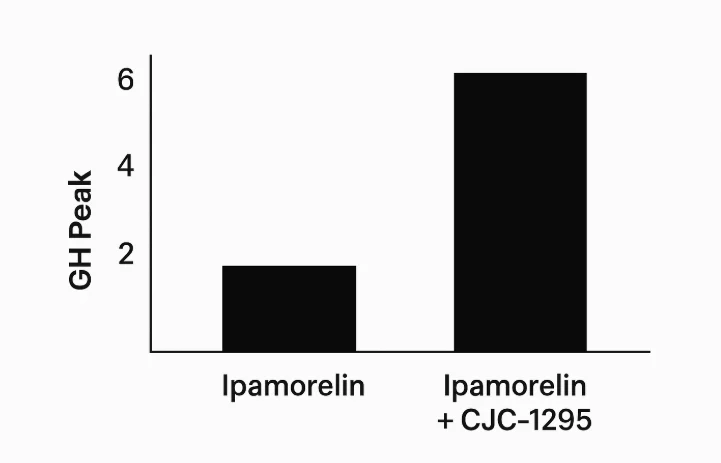
Ipamorelin is sometimes co-administered with GHRH analogs such as CJC-1295 or Modified GRF(1-29). The two peptides act via complementary pathways to amplify GH secretion.
Why this matters: Combination protocols can produce higher and longer GH pulses than Ipamorelin alone.
5. Duration of Research Protocols
Human studies often run 1–2 weeks for acute endocrine response testing. Rodent models may last several weeks for muscle, bone, or metabolic endpoints.
Why this matters: Duration impacts observed outcomes—short-term for biomarker changes, long-term for structural or performance effects.
Limitations
- Dosing data is mostly from short-term studies
- Few standardized protocols across labs
- Rodent doses cannot be directly converted to human equivalent doses without appropriate scaling
Conclusion
Ipamorelin dosing in research varies by species, study design, and endpoint, but typically falls between 200–600 mcg 1–3x daily in human studies and 100–400 mcg/kg/day in animal models. Its short-acting, pulse-like GH stimulation and synergy with GHRH analogs make it a versatile tool for endocrine and tissue repair research.
References
- Raun K, Hansen BS, Johansen NL, et al. Ipamorelin, a novel pentapeptide growth hormone secretagogue. Eur J Endocrinol. 1998;139(5):552–561. https://pubmed.ncbi.nlm.nih.gov/9849815/
- Gobburu JV, et al. Pharmacokinetic-pharmacodynamic modeling of ipamorelin in human volunteers. Pharm Res. 1999;16(9):1473–1479. https://pubmed.ncbi.nlm.nih.gov/10496658/
- Walker RF, et al. Endocrine and metabolic effects of ipamorelin in laboratory animals. Growth Horm IGF Res. 1999;9(4):352–360. https://pubmed.ncbi.nlm.nih.gov/10611799/
- Ghigo E, et al. Endocrine and non-endocrine activities of growth hormone secretagogues. J Endocrinol Invest. 1999;22(5 Suppl):5–10. https://pubmed.ncbi.nlm.nih.gov/10592438/
- Liu Z, et al. Ghrelin receptor agonist improves muscle regeneration in aged mice. Aging Cell. 2017;16(5):1083–1093. https://pubmed.ncbi.nlm.nih.gov/28703462/
- Casanueva FF, et al. Synergistic action of GHRH and GHS on GH release. Trends Endocrinol Metab. 1999;10(1):30–38. https://www.sciencedirect.com/science/article/abs/pii/S1043276098001167
