
 99%+ Purity with 3rd party testing
  10% off first order
  Volume Discounts
  Fast & Free Shipping
  Refund Guarantee
  24/7 Customer Service


DSIP Benefits
What Research Shows
Introduction:
Delta Sleep-Inducing Peptide (DSIP) is a hypothalamic neuropeptide first isolated in the 1970s.¹ While its name comes from early findings suggesting it could induce deep (delta) sleep, later research has expanded into areas such as stress regulation, neuroendocrine balance, and possible cytoprotective effects.²
Because DSIP is still considered experimental, most evidence comes from animal studies and small human trials. Here we summarize the potential benefits researchers are exploring.
Potential Benefits of DSIP
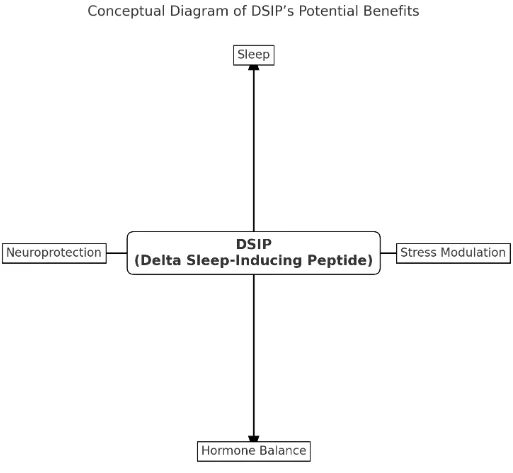
1. Sleep Support
DSIP’s most well-known potential role is in promoting deep sleep. Early studies in animals showed DSIP increased slow-wave (delta) sleep, giving the peptide its name.¹ However, human studies have been mixed, with some showing modest improvements in sleep onset and quality, while others failed to reproduce effects.²
Key takeaway: DSIP may play a role in regulating circadian rhythms and deep sleep, though human data remains inconsistent
2. Stress Regulation
Research suggests DSIP may modulate stress-related hormones, including cortisol and ACTH.³ Animal models show DSIP can dampen the stress response and reduce the physiological impact of stress.
Key takeaway: DSIP may act as a stress-buffering peptide in preclinical models.
3. Endocrine Effects
DSIP has been shown to influence the release of several pituitary hormones:
- Cortisol/ACTH suppression in stressful conditions³
- LH/FSH stimulation in some animal studies³
- Possible indirect growth hormone support via sleep enhancement¹
Key takeaway: DSIP may interact with multiple aspects of hormonal regulation, though results are variable.
4. Neuroprotection & Cytoprotection
Some preclinical studies suggest DSIP may protect against oxidative stress, hypoxia, or metabolic stress.⁴ In these models, DSIP reduced cellular damage and improved survival under stressful conditions.
Key takeaway: DSIP may have protective effects beyond sleep and hormones, but this is early-stage research.
5. How DSIP Compares to Melatonin
Because DSIP is often studied for sleep regulation, it is natural to compare it with melatonin, the most widely used sleep supplement:
| Feature | DSIP | Melatonin |
| Origin | Endogenous hypothalamic peptide (9 amino acids) | Hormone produced by pineal gland |
| Mechanism | Acts on multiple pathways: hypothalamus, pituitary, GABA/serotonin systems¹² | Regulates circadian rhythm via MT1/MT2 receptors |
| Evidence | Animal studies suggest slow-wave sleep promotion; human data inconsistent¹² | Well-studied in humans, improves sleep onset, especially in circadian disruption |
| Other Effects | Stress hormone modulation, potential neuroprotection³⁴ | Primarily circadian and sleep regulation |
| Status | Research peptide, not approved for human use | Widely available OTC supplement |
Key takeaway:
- Melatonin has strong human evidence for improving sleep onset, especially in jet lag or circadian rhythm disorders.
- DSIP is experimental with mixed evidence, studied for a broader range of effects (stress, endocrine, neuroprotection), but lacks clinical validation.
Limitations of Current Evidence
- Mixed results in humans: Some trials failed to confirm consistent sleep benefits.²
- Short half-life: DSIP breaks down quickly in plasma, limiting its effectiveness.³
- Unclear mechanism: DSIP appears to act through multiple pathways rather than a single receptor.⁴
Summary
Research into DSIP benefits suggests potential roles in:
- Supporting sleep regulation
- Reducing stress responses
- Modulating endocrine hormones
- Providing cytoprotective effects in stressful environments
Compared to melatonin, DSIP is far less studied but potentially broader in scope, influencing multiple systems beyond sleep.
FAQs About DSIP Benefits
Does DSIP help with sleep?
Animal studies suggest sleep-promoting effects, but human results have been inconsistent.
Can DSIP reduce stress?
Yes, preclinical studies show DSIP may reduce cortisol and ACTH responses to stress.
Does DSIP affect hormones?
Research suggests DSIP may influence LH, FSH, cortisol, ACTH, and possibly growth hormone, but results vary.
How does DSIP compare to melatonin?
Melatonin is clinically validated for sleep onset and circadian rhythm adjustment. DSIP remains experimental with broader but unproven effects
Related Article
References
- Monnier M, et al. “Delta Sleep-Inducing Peptide: Isolation, Structure, and Biological Effects.” Proc Natl Acad Sci U S A. 1977;74(9): 4767–4771. https://www.ncbi.nlm.nih.gov/pmc/articles/PMC431962/
- Kovalzon VM. “Delta sleep-inducing peptide: 30 years of research.” J Sleep Res. 2006;15(4):305–320. https://pubmed.ncbi.nlm.nih.gov/17118190/
- Graf MV, Kastin AJ. “Delta sleep-inducing peptide (DSIP): Current status.” Peptides. 1986;7(2):241–248. https://pubmed.ncbi.nlm.nih.gov/2940287/
- Kovalzon VM, et al. “Sleep-promoting and stress-protective functions of DSIP: unresolved issues.” Front Neurosci. 2017;11:561. https://www.frontiersin.org/articles/10.3389/fnins.2017.00561/full
