
 99%+ Purity with 3rd party testing
  10% off first order
  Volume Discounts
  Fast & Free Shipping
  Refund Guarantee
  24/7 Customer Service


MOTS-C Benefits
What Research Shows
Introduction:
MOTS-C is a mitochondrial-derived peptide (MDP) that plays a unique role in regulating metabolism, energy balance, and stress responses.¹² Preclinical research and early human studies suggest that MOTS-C may have potential benefits across metabolic health, exercise performance, and healthy aging.
This article reviews the most studied and promising benefits of MOTS-C.
1. Improved Metabolic Health
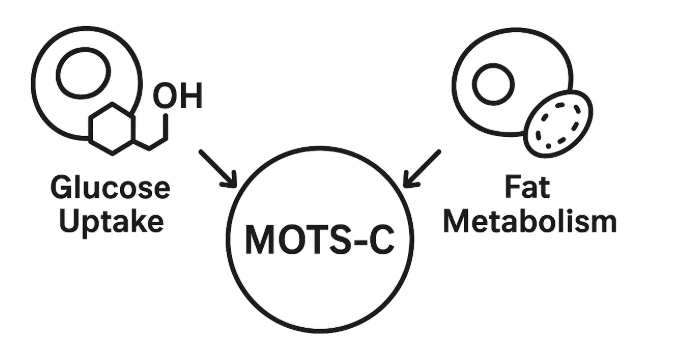
- Enhances glucose uptake by increasing GLUT4 transporters in muscle cells.¹
- Improves insulin sensitivity, counteracting resistance seen in obesity and type 2 diabetes.¹²
- Reduces fat accumulation through increased fatty acid oxidation.²
- Why it matters: Positions MOTS-C as a research candidate for obesity, diabetes, and metabolic syndrome.
2. Exercise Performance & Endurance
- MOTS-C levels rise naturally during physical activity.²
- Supports mitochondrial function and energy metabolism during exercise.³
- In mouse models, supplementation improved endurance and delayed fatigue.²
- Why it matters: MOTS-C is sometimes referred to as an “exercise-mimicking peptide”, highlighting its role in physical performance.
3. Healthy Aging & Longevity
- MOTS-C levels decline with age, correlating with reduced metabolic flexibility.³
- Animal studies showed MOTS-C extended healthspan and lifespan, improving markers of physical and metabolic aging.⁴
- Early research suggests MOTS-C could buffer age-related decline in humans.⁵
- Why it matters: Makes MOTS-C a promising focus for longevity and geroscience research
4. Stress Resistance & Adaptation
- MOTS-C helps cells adapt to metabolic stress (nutrient deprivation, exercise).²
- Boosts resilience by enhancing mitochondrial efficiency.³
- Why it matters: Supports the idea that MOTS-C acts as a stress-response peptide, helping organisms maintain balance in challenging conditions
Summary
MOTS-C has been linked to better glucose regulation, enhanced endurance, stress resilience, and longevity effects in animal and early human research. While human clinical trials remain limited, these findings make MOTS-C one of the most promising mitochondrial-derived peptides in modern research.
FAQs About MOTS-C Benefits
Does MOTS-C improve weight loss?
In animal studies, MOTS-C reduced fat mass and improved insulin sensitivity, but human results are preliminary.
Can MOTS-C improve exercise endurance?
Yes, studies show increased endurance and delayed fatigue in animal and early human research.
Is MOTS-C an anti-aging peptide?
It may play a role in aging research, but human clinical evidence is still limited.
Are the benefits proven in humans?
Most benefits are based on animal and preclinical data; large human trials are still needed.
Related Articles
- What is MOTS-C
- How Does MOTS-C Work
- MOTS-C Side Effects & Safety
- What is NAD+
- How Does NAD+ Work
- NAD+ Benefits
- NAD+ Side Effects & Safety
- NAD vs NMN vs NR
References
- Lee C, et al. “The mitochondrial-derived peptide MOTS-c promotes metabolic homeostasis and reduces obesity and insulin resistance.” Cell Metab. 2015;21(3):443–454. https://pubmed.ncbi.nlm.nih.gov/25738459/
- Reynolds JC, et al. “MOTS-c is an exercise-induced mitochondrial-encoded regulator of age-dependent physical decline.” Nat Commun. 2021;12:470. https://pubmed.ncbi.nlm.nih.gov/33563973/
- Zarse K, Ristow M. “Mitochondrial peptides and aging: a new perspective.” Exp Gerontol. 2020;130:110791. https://pubmed.ncbi.nlm.nih.gov/31731158/
- Lu H, et al. “Mitochondrial-derived peptide MOTS-c increases healthspan and lifespan in mice.” Aging Cell. 2019;18(6):e13030. https://pubmed.ncbi.nlm.nih.gov/31608986/
- Quevedo H, et al. “MOTS-c clinical potential in metabolic disease and aging.” Front Endocrinol. 2022;13:890123. https://pubmed.ncbi.nlm.nih.gov/35669234/
