
 99%+ Purity with 3rd party testing
  10% off first order
  Volume Discounts
  Fast & Free Shipping
  Refund Guarantee
  24/7 Customer Service


Retatrutide Benefits
What Research Shows
Introduction:
Retatrutide is a next-generation triple agonist peptide that targets GLP-1, GIP, and glucagon receptors.¹ Early research suggests this combination may yield greater metabolic effects than semaglutide (GLP-1 only) or tirzepatide (GLP-1/GIP).
This article reviews the potential benefits of retatrutide in research settings, with emphasis on weight loss, glucose regulation, lipid metabolism, and emerging applications
For research use only — not for human consumption.
1. Weight Loss Benefits
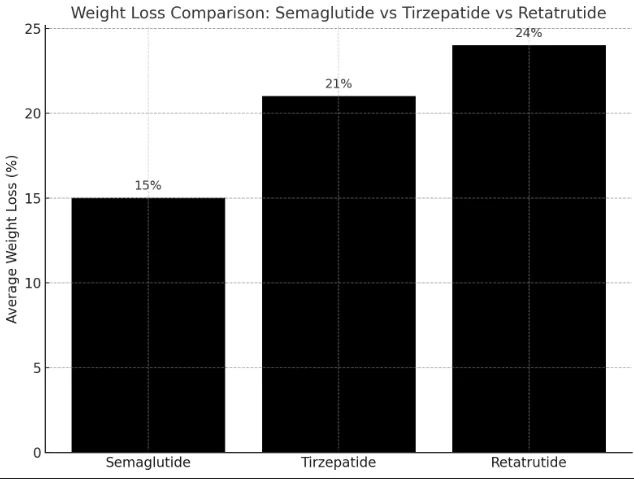
- In a 48-week Phase 2 trial, participants on retatrutide achieved average body weight reductions exceeding 24% at the highest doses — greater than reductions typically seen with semaglutide or tirzepatide.²
- Weight loss was consistent across BMI categories, suggesting broad applicability.
- Appetite suppression, delayed gastric emptying, and increased energy expenditure likely contribute.³
2. Glucose Regulation
- Retatrutide improves insulin secretion while reducing glucagon release in a glucose-dependent manner.¹
- Early studies report significant HbA1c reductions, rivaling other incretin therapies.²
- GIP receptor activation enhances insulin sensitivity, contributing to long-term glycemic control.⁴
3. Lipid & Metabolic Health
- Research indicates favorable changes in cholesterol and triglyceride levels.²
- Glucagon receptor activation increases fat oxidation, potentially benefiting fatty liver and cardiometabolic health.⁵
- May reduce visceral adiposity, improving overall metabolic risk profile.
4. Emerging Applications
- Fatty liver disease (NAFLD/NASH): Studies are exploring whether triple-agonism improves liver fat content.
- Cardiovascular research: Potential improvements in blood pressure, lipids, and inflammatory markers.
- Combination therapies: Retatrutide may complement existing incretin agonists or novel agents.
Summary
Retatrutide’s triple-agonist design has demonstrated:
- Superior weight loss outcomes compared to existing incretin therapies.
- Robust glucose-lowering and insulin-sensitizing effects.
- Potential improvements in lipid metabolism and cardiovascular health.
While promising, its benefits are based on early-stage clinical trials; long-term data are needed.
FAQs About Retatrutide Benefits
What is the main benefit of retatrutide in research?
Significant weight loss (>24% in some studies) and improved metabolic health.
Is retatrutide better than semaglutide or tirzepatide?
Early evidence suggests greater weight loss, though safety and long-term outcomes need confirmation.
Does retatrutide help with fatty liver disease?
Ongoing studies are investigating potential benefits for NAFLD/NASH.
Related Articles
- What is Retatrutide
- How Does Retatrutide Work
- Retatrutide Side Effects & Safety
- Semaglutide vs Tirzepatide vs Retatrutide
- Semaglutide Benefits
- Tirzepatide Benefits
- Retatrutide Clinical Trials
References
- Coskun T, et al. LY3437943 (retatrutide), a triple agonist for metabolic research. Sci Transl Med. 2022;14(657):eabn3105. https://pubmed.ncbi.nlm.nih.gov/35732387/
- Jastreboff AM, et al. Retatrutide triple-agonist obesity trial. N Engl J Med. 2023;389(2):145–158. https://pubmed.ncbi.nlm.nih.gov/37363997/
- Drucker DJ. Mechanisms of incretin hormones in obesity. Cell Metab. 2018;27(4):740–756. https://pubmed.ncbi.nlm.nih.gov/29617643/
- Finan B, et al. Synergistic action of GLP-1 and GIP in glucose control. Nat Med. 2013;19(6):701–708. https://pubmed.ncbi.nlm.nih.gov/23685719/
- Tillner J, et al. Glucagon receptor agonism and energy metabolism. Diabetes Obes Metab. 2019;21(5):1206–1215. https://pubmed.ncbi.nlm.nih.gov/30767286/
