
 99%+ Purity with 3rd party testing
  10% off first order
  Volume Discounts
  Fast & Free Shipping
  Refund Guarantee
  24/7 Customer Service


Semaglutide Benefits
What Research Shows
Introduction:
Semaglutide is a GLP-1 receptor agonist peptide studied for its effects on glucose regulation, appetite control, and weight management.¹² As a modified analog of the natural GLP-1 hormone, semaglutide has a prolonged half-life, allowing for sustained receptor activation and widespread systemic effects.³
This article reviews the key benefits of semaglutide in research, highlighting findings from both preclinical and clinical studies.
For research use only — not for human consumption.
1. Weight Reduction & Appetite Control
One of the most well-documented semaglutide benefits is its ability to reduce body weight by lowering appetite and food intake.⁴
- Acts on hypothalamic GLP-1 receptors to increase satiety and reduce hunger.⁵
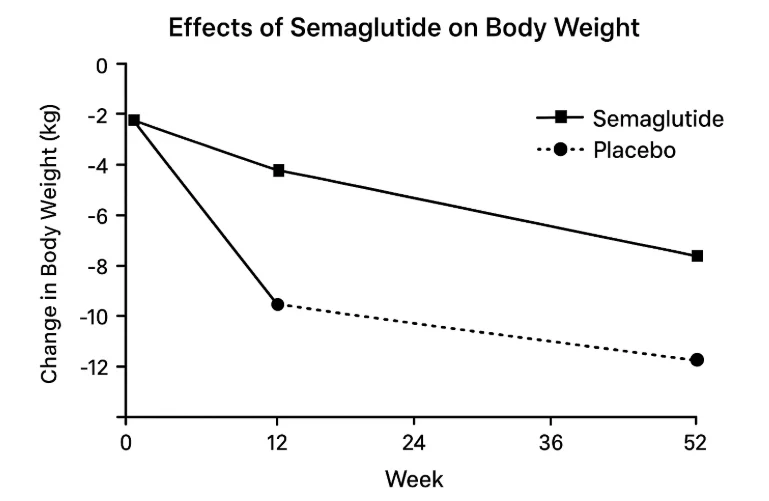
- Clinical trials show significant reductions in body weight compared to placebo.⁶
- Effects appear durable when sustained over extended dosing periods.
Why this matters: Appetite suppression and weight reduction are central to semaglutide’s role in metabolic research.
2. Glucose Regulation
Semaglutide improves glucose-dependent insulin secretion and reduces glucagon release.⁷
- Lowers fasting and post-meal glucose levels.
- Reduces HbA1c in type 2 diabetes research settings.⁸
Why this matters: This dual action provides a more balanced glucose profile while lowering risk of hypoglycemia.
3. Gastric Emptying Delay
Semaglutide slows gastric emptying, which reduces the rate at which glucose enters the bloodstream.⁹
- Results in smaller postprandial glucose spikes.
- Helps smooth out daily glucose fluctuations.
Why this matters: Stable blood glucose profiles are critical in metabolic studies.
4. Cardiometabolic Benefits
Research suggests semaglutide may improve cardiovascular outcomes:¹⁰
- Enhances endothelial function.
- Reduces markers of inflammation.
- Associated with lower rates of adverse cardiovascular events in human trials.
Why this matters: Cardiometabolic effects expand semaglutide’s relevance beyond glucose and weight regulation.
5. Liver and Body Composition Effects
Emerging studies indicate semaglutide may influence fat distribution and liver health:¹¹
- Decreases visceral adiposity.
- Reduces markers of nonalcoholic fatty liver disease (NAFLD).
Why this matters: This highlights potential broader benefits in metabolic and obesity-related research.
Limitations of Current Research
- Most benefits are documented in clinical trials with patients, but translation into research peptide contexts should be made cautiously.
- Long-term effects on weight maintenance and metabolic health are still being studied.
- Semaglutide acts through a single receptor, unlike multi-target peptides such as BPC-157.
FAQs About Semaglutide Benefits
What are the main benefits of semaglutide?
Semaglutide benefits include weight reduction, appetite control, glucose regulation, delayed gastric emptying, and cardiometabolic improvements.
Does semaglutide help with weight loss?
Yes. Research shows semaglutide reduces appetite and promotes satiety, leading to significant weight reduction compared to placebo.
How does semaglutide improve glucose regulation?
Semaglutide enhances insulin secretion in a glucose-dependent manner and suppresses glucagon, resulting in more balanced blood sugar control.
Related Articles
- What is Semaglutide
- How Does Semaglutide Work
- Semaglutide Side Effects & Safety
- Semaglutide vs Tirzepatide vs Retatrutide
- Tirzepatide Benefits
- Retatrutide Benefits
Summary
Semaglutide demonstrates multiple research-backed benefits: weight reduction, appetite control, glucose regulation, gastric emptying delay, and cardiometabolic improvements. These effects make it a key GLP-1 peptide of interest in metabolic research, though further studies are needed to fully understand its long-term potential.
References
- Holst JJ. The physiology of glucagon-like peptide 1. Physiol Rev. 2007;87(4):1409–1439. https://pubmed.ncbi.nlm.nih.gov/17928588/
- Drucker DJ. Mechanisms of action and therapeutic application of GLP-1. Cell Metab. 2018;27(4):740–756. https://pubmed.ncbi.nlm.nih.gov/29617643/
- Lau J, et al. Discovery of the once-weekly GLP-1 analog semaglutide. J Med Chem. 2015;58(18):7370–7380. https://pubmed.ncbi.nlm.nih.gov/26262820/
- Wilding JPH, et al. Body-weight reduction with semaglutide. N Engl J Med. 2021;384:989–1002. https://pubmed.ncbi.nlm.nih.gov/33567185/
- van Can J, et al. Effects of once-weekly semaglutide on appetite control. Diabetes Obes Metab. 2014;16(9):834–842. https://pubmed.ncbi.nlm.nih.gov/24845069/
- Davies M, et al. Semaglutide once weekly for type 2 diabetes. N Engl J Med. 2017;377:723–732. https://pubmed.ncbi.nlm.nih.gov/28614620/
- Nauck MA, et al. Effects of GLP-1 on insulin secretion. Diabetologia. 1993;36(8):741–744. https://pubmed.ncbi.nlm.nih.gov/8405741/
- Pratley RE, et al. Semaglutide vs dulaglutide in T2D. Lancet Diabetes Endocrinol. 2018;6(4):275–286. https://pubmed.ncbi.nlm.nih.gov/29483060/
- Flint A, et al. Semaglutide and gastric emptying. Diabetes Obes Metab. 2020;22(6):911–921. https://pubmed.ncbi.nlm.nih.gov/32017130/
- Marso SP, et al. Semaglutide and cardiovascular outcomes in patients with type 2 diabetes. N Engl J Med. 2016;375:1834–1844. https://pubmed.ncbi.nlm.nih.gov/27633186/
- Newsome PN, et al. Semaglutide in nonalcoholic steatohepatitis. N Engl J Med. 2021;384:1113–1124. https://pubmed.ncbi.nlm.nih.gov/33596356/
