
 99%+ Purity with 3rd party testing
  10% off first order
  Volume Discounts
  Fast & Free Shipping
  Refund Guarantee
  24/7 Customer Service


Sermorelin Benefits
Research Insights & Potential Applications
Introduction:
Sermorelin is a synthetic growth hormone–releasing hormone (GHRH) analog studied for its ability to stimulate natural, pulsatile growth hormone (GH) release.¹² In research contexts, this controlled activation of the GH–IGF-1 axis has been associated with multiple physiological effects — from changes in body composition to endocrine health markers.
For research use only — not for human use. All potential benefits discussed are based on published research in animals, cells, and limited clinical studies.
Key Benefits Observed in Research
1. Stimulates Physiologic Growth Hormone Release
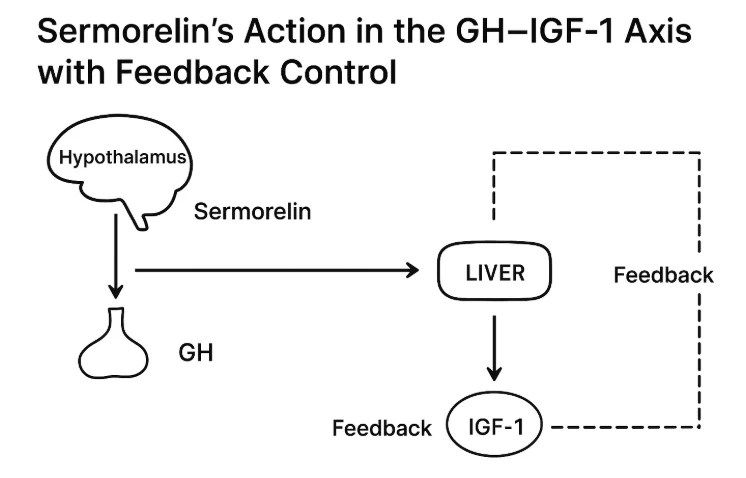
Sermorelin binds to GHRH receptors in the pituitary, leading to short bursts of GH secretion.¹ Unlike direct GH administration, it maintains natural negative feedback control through somatostatin and IGF-1 levels.
Why this matters: Mimicking physiologic GH rhythms may reduce the risk of side effects associated with constant hormone exposure.
2. Supports Lean Body Mass in Research Models
Animal and limited human studies show that GH pulses induced by Sermorelin can promote protein synthesis and muscle fiber repair, leading to favorable changes in body composition.³
Why this matters: Lean mass preservation is a key endpoint in aging and muscle recovery research.
3. Potential Recovery and Tissue Support
GH and IGF-1 influence connective tissue remodeling, collagen synthesis, and post-injury recovery.⁴ Sermorelin’s indirect stimulation of these pathways has been explored in models of muscle and tendon repair.
Why this matters: Recovery studies can help clarify how GH axis modulation affects healing dynamics.
4. Sleep Quality and Hormone Regulation
Some research suggests that enhanced GH pulses may correlate with improved slow-wave (deep) sleep, a phase linked to hormone balance and tissue repair.⁵Why this matters: Sleep quality is a critical variable in both endocrine research and performance recovery studies.
5. Diagnostic Tool in Endocrinology Research
Originally, Sermorelin was used in GH stimulation tests to evaluate pituitary function.² Even today, it is valuable in research protocols aimed at mapping GH responsiveness.
Why this matters: This makes Sermorelin unique among peptides — with both functional and diagnostic potential.
Limitations & Research Gaps
- Most data come from animal models and short-term human studies.
- Long-term safety and efficacy in specific research populations remain underexplored.
- Effects may vary depending on timing, dose, and baseline endocrine function
Summary
In research, Sermorelin’s benefits stem from its ability to stimulate GH naturally, supporting lean mass, tissue recovery, and hormone balance while preserving feedback control. While findings are promising, more studies are needed to confirm its long-term role in various research models.
FAQs About Sermorelin Benefits
What are the benefits of Sermorelin in research?
Sermorelin may stimulate physiologic growth hormone release, support lean mass, aid tissue recovery, and serve as a diagnostic tool in GH axis research.
Does Sermorelin improve recovery?
Research suggests that GH pulses induced by Sermorelin may support connective tissue repair and collagen synthesis, potentially aiding recovery.
Can Sermorelin be used for GH testing?
Yes. Sermorelin has been used as a GH stimulation agent to assess pituitary function in research settings.
Related Articles
- What is Sermorelin
- How Does Sermorelin Work
- Sermorelin Side Effects & Safety
- Ipamorelin vs Sermorelin vs Tesamorelin
- What is Ipamorelin
- How Does Ipamorelin Work
- Ipamorelin Benefits
- Ipamorelin Side Effects & Safety
References
- Thorner MO, et al. Sermorelin: a growth hormone–releasing hormone analog. J Clin Endocrinol Metab. 1986;62(4):648–653. https://pubmed.ncbi.nlm.nih.gov/3004674/
- Walker RF, et al. Stimulation of growth hormone secretion by Sermorelin in humans. Endocr Rev. 1994;15(1):1–14. https://pubmed.ncbi.nlm.nih.gov/8156948/
- Veldhuis JD, et al. Hormonal mechanisms of muscle protein metabolism in aging. J Endocrinol Invest. 2005;28(9):S86–S92. https://pubmed.ncbi.nlm.nih.gov/16382192/
- Doessing S, et al. Growth hormone stimulates tendon collagen synthesis in humans. J Appl Physiol. 2010;108(3):625–632. https://pubmed.ncbi.nlm.nih.gov/20044472/
- Van Cauter E, et al. Roles of sleep and circadian rhythms in growth hormone regulation. J Clin Invest. 2000;107(2):163–168. https://pubmed.ncbi.nlm.nih.gov/10637265/
